While all 18-karat horological gold alloys contain exactly 75.0% pure elemental gold (Au750), their color, density (15.15 to 16.05 g/cm3), and Vickers micro-hardness (155 to 215 HV) are governed by the remaining 25.0% ternary balance of silver (Ag), copper (Cu), palladium (Pd), and platinum (Pt).
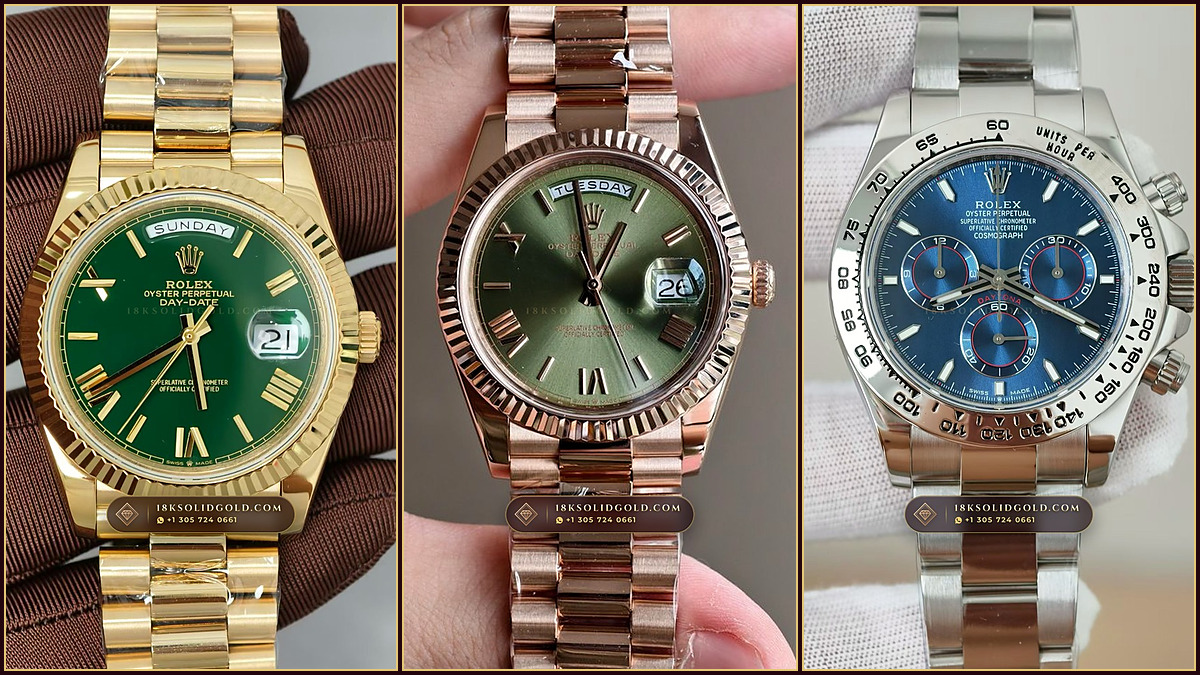
Key Quantitative Laboratory Takeaways
- 18K Yellow Gold (75.0% Au, 12.5% Ag, 12.5% Cu) achieves a specific gravity of 15.58 g/cm3 and the classic solar warmth seen on the Daytona Ref. 116508.
- 18K Everose / Sedna Rose Gold incorporates 1.8% to 2.2% pure Platinum (Pt) alongside ~20.5% Copper (Cu), locking the copper atoms against chloride oxidation so the warm rose hue never fades.
- Horological 18K White Gold (75.0% Au, 13.0%–15.0% Pd, Ag/Cu) is alloyed with high palladium content so it requires zero rhodium electroplating and maintains its warm metallic lustre even after polishing.
- Work-hardening solid 18K gold billets under 200-ton hydraulic pressure prior to 5-axis CNC milling raises surface hardness from ~140 HV (cast) to 195–215 HV.
| Alloy Designation | Gold (Au %) | Silver (Ag %) | Copper (Cu %) | Pd / Pt Stabilizer (%) | Density (g/cm3) | Vickers Hardness (HV) |
|---|---|---|---|---|---|---|
| 18K 3N Yellow Gold | 75.05% | 12.50% | 12.45% | 0.00% | 15.58 g/cm3 | 165 – 180 HV (Forged) |
| 18K 5N Rose / Pink Gold | 75.05% | 4.50% | 20.45% | 0.00% | 15.18 g/cm3 | 175 – 195 HV (Forged) |
| 18K Everose / Sedna Gold | 75.05% | 2.20% | 20.75% | 2.00% Platinum (Pt) | 15.32 g/cm3 | 190 – 210 HV (Forged) |
| 18K Palladium White Gold | 75.05% | 4.00% | 6.95% | 14.00% Palladium (Pd) | 15.95 g/cm3 | 185 – 215 HV (Forged) |
| 950 Horological Platinum | 0.00% | 0.00% | 0.00% | 95.0% Pt + 5.0% Ru | 21.45 g/cm3 | 135 – 155 HV (Dense) |
Why Does 18K Everose Gold Never Lose Its Warm Pink Hue?
Traditional 18K pink and red gold alloys derive their warm coloration from a 19% to 21% copper (Cu) fraction; however, when exposed to marine saltwater, chlorine, or ultraviolet radiation over decades, surface copper atoms can leach out, shifting ordinary rose gold toward a pale yellow tone. To eliminate this phenomenon permanently, horological 18K Everose gold alloys 75.0% pure gold with approximately 20.75% oxygen-free copper, 2.2% silver, and 2.0% pure platinum (Pt).
Platinum forms a noble intermetallic lattice bond with copper inside the solid solution, increasing the electrochemical corrosion potential of the alloy. When inspected under our Fischer XRF spectrometer at Place Vendome, this 2.0% platinum signature immediately distinguishes authentic horological Everose cases from ordinary jewelry-grade 18K rose gold.

Why Does White Gold Weigh Slightly More Than Yellow Gold in the Same Watch?
Collectors comparing a solid 18K White Gold Rolex Daytona Ref. 116509 (221.4g) against a solid 18K Yellow Gold Daytona Ref. 116508 (216.5g) frequently notice a 4.5-gram to 5.0-gram mass premium on the white gold reference. This difference stems directly from atomic density: whereas 18K yellow gold uses equal parts silver (10.49 g/cm3) and copper (8.96 g/cm3) for its remaining 25% alloy balance, horological 18K white gold replaces most of that silver and copper with 13% to 15% pure palladium (Pd, density 12.02 g/cm3) and trace platinum.
Because palladium is significantly denser than copper and silver—and bleaches the natural yellow colour of Au750 throughout the entire thickness of the billet—solid 18K palladium white gold achieves a higher specific gravity (15.95 g/cm3 vs. 15.58 g/cm3) and never requires superficial rhodium plating that could flake during case refinishing.

| Watch Collection | 18K Yellow Gold Ref. & Mass | 18K Everose / Rose Ref. & Mass | 18K White Gold Ref. & Mass | Bracelet Architecture |
|---|---|---|---|---|
| Rolex Cosmograph Daytona | Ref. 116508 (216.5g) | Ref. 116505 (219.8g) | Ref. 116509 (221.4g) | Solid 18K Oyster 3-Link + Easylink |
| Rolex Day-Date 40 President | Ref. 228238 (208.2g) | Ref. 228235 (209.6g) | Ref. 228239 (212.5g) | Solid 18K President Ceramic-Insert Links |
| Patek Philippe Nautilus 40mm | Ref. 5711/1J (185.4g) | Ref. 5711/1R-001 (186.8g) | Ref. 5711/1G (189.2g) | Integrated Solid 18K Satin/Polished Links |
| Audemars Piguet Royal Oak 41mm | Ref. 15510BA (207.8g) | Ref. 15500OR (208.4g) | Ref. 15500BC (211.6g) | Integrated AP Tapering 18K Stud Links |
| Rolex GMT-Master II 40mm | Ref. 126718GRNR (214.6g) | Ref. 126715CHNR (216.2g) | Ref. 126719BLRO (219.0g) | Solid 18K Oyster / Jubilee Bracelet |
How Does Cold Forging Increase the Scratch Resistance of 18K Gold Cases?
Pure 24-karat gold (Au999) has a Vickers hardness of only 25 to 30 HV, making it far too soft for a water-resistant mechanical wristwatch case or integrated bracelet. By alloying 75.0% pure gold with copper, silver, palladium, and platinum, the baseline cast hardness rises to roughly 140 HV. Before any middle case, bezel, or bracelet link is milled for our Place Vendome vitrines, the vacuum-cast Au750 billet undergoes multi-stage hydraulic cold-forging and controlled age-hardening heat treatment.
This mechanical deformation compresses the crystalline grain boundaries and induces precipitation hardening across the gold-copper superlattice, elevating final surface hardness to 190–215 HV—comparable to Austenitic 316L stainless steel—while preserving the unmistakable thermal conductivity and 210+ gram wrist presence of solid 18-karat bullion.

Explore Verified Rolex Solid 18K Gold References in Our Register
Every timepiece referenced in this monograph is available for immediate allocation with pre-shipment 4K Mettler-Toledo gram weighing, Fischer XRF Au750 spectroscopy, and 6-position Witschi Chronoscope certification. Navigate directly to the 18K SOLID GOLD Homepage Master Register, the Rolex Solid 18K Gold Collection Hub, or the Complete 774-Watch Catalogue:
Ph.D. in Precious Metal Crystallography (ETH Zurich), 22 Years in Geneva & Paris Horological Assaying.
More Horological Monographs in the 18K SOLID GOLD Journal
- Swiss St. Bernard Poincon, Au750 Scales & Place Vendome Eagle Head Hallmarks: Complete Metallurgical Guide (August 12, 2026)
- Solid 18K Gold (Au750) vs. PVD Gold-Plated & Tungsten Watches: Gravimetric Scale & XRF Detection Protocol (September 9, 2026)
- Patek Philippe Nautilus & Aquanaut Solid 18K Rose Gold Weight Index: Ref. 5711/1R, 5712/1R, 5980/1R & 5167R (September 24, 2026)
- 950 Platinum (Pt950) & Ice-Blue Dial Horology: Why the Rolex Daytona Platona 116506 Weighs 282.0 Grams (October 8, 2026)
- View All 18K SOLID GOLD Research Journal Articles →