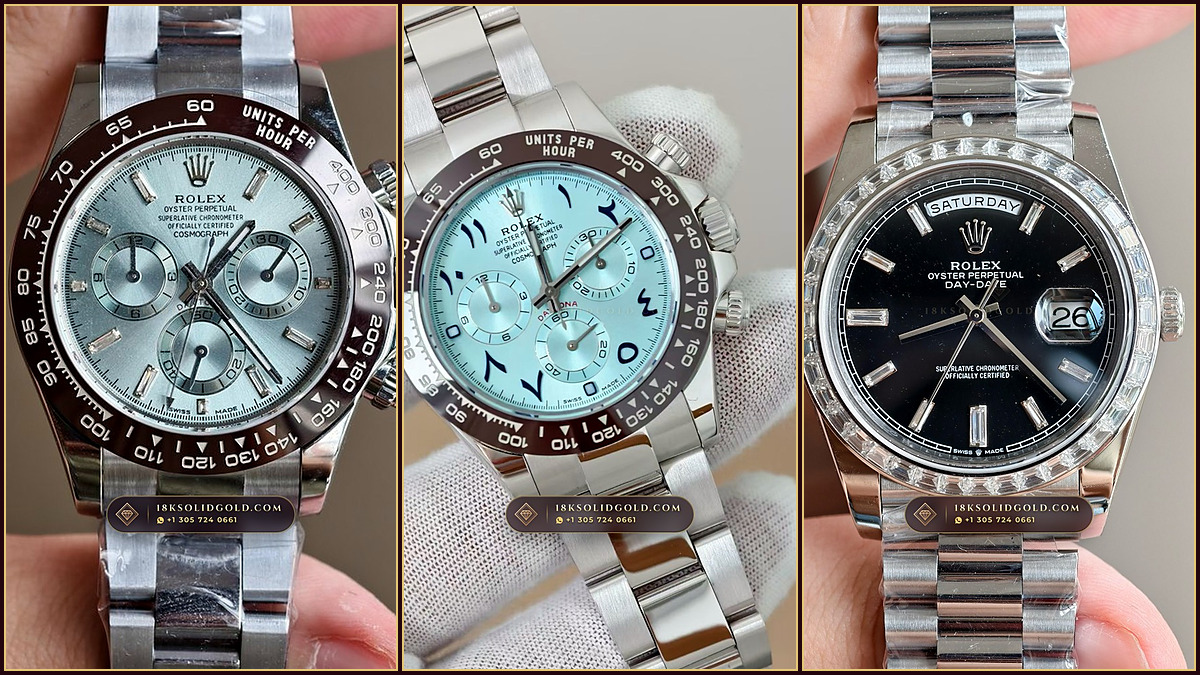
Crafted at 950 parts per thousand (95.0% pure platinum alloyed with 5.0% ruthenium), horological Pt950 possesses an extraordinary density of 21.45 g/cm3—nearly 38% denser than 18K gold (15.58 g/cm3)—enabling flagship ice-blue dial models like the Rolex Cosmograph Daytona Platona Ref. 116506 and 126506 to achieve a verified mass of 282.0 grams.
Key Quantitative Laboratory Takeaways
- At 21.45 g/cm3, 950 Platinum is the densest noble metal used in Swiss watchmaking, pushing the Daytona Platona (282.0g) 65.5 grams heavier than the 18K yellow gold Daytona (216.5g).
- In Geneva horology, the glacially metallic Ice-Blue sunburst and guilloche dial shade is reserved exclusively for timepieces cased in 950 Platinum (Daytona 116506/126506, Day-Date 228236, Perpetual 1908).
- Machining Pt950 requires specialized diamond-coated CNC tooling running at 30% of normal feed speeds due to platinum's high ductility and tool-galling resistance.
- Unlike scratches on steel or gold that remove microscopic metal shavings, a scratch on Pt950 merely displaces the metal laterally (developing a prized patina) with zero mass loss.
| Metallurgical Property | 950 Platinum (Pt950 / Ru50) | 18K White Gold (Au750 / Pd) | 904L Stainless Steel |
|---|---|---|---|
| Noble Metal Fineness | 95.0% Pure Platinum + 5.0% Ruthenium | 75.0% Pure Gold + ~14.0% Palladium | 0.0% Noble Metal (Fe-Cr-Ni-Mo) |
| Specific Gravity (Density) | 21.45 g/cm3 (Highest Noble Density) | 15.95 g/cm3 | 7.98 g/cm3 |
| Melting Point Temperature | 1,768 deg C (3,214 deg F) | 1,064 – 1,120 deg C | 1,400 – 1,450 deg C |
| Daytona Full-Bracelet Mass | 281.8g – 282.4g (Ref. 116506 / 126506) | 221.4g (Ref. 116509) | 141.2g (Ref. 116500LN) |
| Optical Reflectance Tone | Brilliant Silver-White (Zero Yellow Cast) | Warm Steely Grey | Industrial Chromium Grey |
| Signature Exclusive Dial | Glacial Ice-Blue Sunburst / Baguette | Steel/Black Panda, Blue, Meteorite | White or Black Lacquer |
Why Does the Platinum Daytona 116506 Weigh 282.0 Grams?
At 282.0 grams on a calibrated Mettler-Toledo laboratory balance, the Rolex Cosmograph Daytona Platona Ref. 116506 (and its sapphire-caseback successor Ref. 126506) stands at the apex of horological gravimetry. Because pure platinum has an atomic mass of 195.08 u and a crystal lattice density of 21.45 g/cm3, every cubic centimeter of the Oyster case, screw-down pushers, and solid three-piece Oyster bracelet links carries 37.6% more mass than 18K yellow gold and 168.8% more mass than 904L steel.
To ensure that the solid Pt950 Oyster bracelet resists stretching under this 282-gram load, internal ceramic sleeves surround the link pins, and the alloy is hardened with 5.0% ruthenium (Ru) to achieve optimal tensile strength.

Why Is the Ice-Blue Dial Exclusive to 950 Platinum Watches?
Across Swiss haute horlogerie, the glacial ice-blue dial is an unspoken code understood only by seasoned collectors: a watch bearing an authentic factory ice-blue dial is cased exclusively in 950 Platinum. Produced via Physical Vapor Deposition (PVD) over a radially brushed brass or solid gold dial plate and finished with micro-coats of clear zapon lacquer, the ice-blue tone shifts from pale arctic silver to vivid sky blue depending on the angle of incident light.
On the Daytona Ref. 116506 and 126506, this cool metallic blue is contrasted against a warm chestnut-brown monobloc Cerachrom tachymeter bezel with platinum-sputtered numerals and optional baguette-cut diamond hour markers.

| Reference Number | Model & Bezel Configuration | Dial Specification | Verified Weight (g) | Movement Calibre |
|---|---|---|---|---|
| Rolex Daytona Ref. 116506 | Chestnut Brown Cerachrom Bezel | Ice-Blue Sunburst / Chestnut Subdials | 282.0g | Cal. 4130 Column-Wheel |
| Rolex Daytona Ref. 116506-BAG | Chestnut Brown Cerachrom Bezel | Ice-Blue with 11 Baguette Diamonds | 282.4g | Cal. 4130 Column-Wheel |
| Rolex Daytona Ref. 126506 | Pt950-Ringed Chestnut Cerachrom | Ice-Blue / Display Caseback Pt950 Rotor | 282.2g | Cal. 4131 Chronergy |
| Rolex Day-Date 40 Ref. 228236 | Machine-Fluted Pt950 Bezel | Ice-Blue Roman / Diagonal Motif | 256.4g | Cal. 3255 Automatic |
| Patek Philippe Nautilus Ref. 5711/1P | Octagonal Brushed Pt950 + Top Wesselton | Anniversary Blue Sunburst Baguette | 244.8g | Cal. 26-330 S C |
How Fischer XRF Validates Pt950 Ruthenium Alloys Before Dispatch
Testing a 950 Platinum timepiece on our Fischer XRF spectrometer produces an unmistakable spectral readout centered on the platinum L-alpha (9.44 keV) and L-beta (11.07 keV) emission lines at 95.00%–95.20% concentration, accompanied by a 4.80%–5.00% ruthenium (Ru) or iridium (Ir) alloying peak. Unlike white gold or stainless steel, Pt950 requires zero surface coating to achieve its brilliant silver-white sheen, and every client receives a live 4K video of both the 282.0g scale reading and the Pt950 XRF spectrum before insured armored delivery.

Explore Verified Rolex Solid 18K Gold References in Our Register
Every timepiece referenced in this monograph is available for immediate allocation with pre-shipment 4K Mettler-Toledo gram weighing, Fischer XRF Au750 spectroscopy, and 6-position Witschi Chronoscope certification. Navigate directly to the 18K SOLID GOLD Homepage Master Register, the Rolex Solid 18K Gold Collection Hub, or the Complete 774-Watch Catalogue:
Ph.D. in Precious Metal Crystallography (ETH Zurich), 22 Years in Geneva & Paris Horological Assaying.
More Horological Monographs in the 18K SOLID GOLD Journal
- Swiss St. Bernard Poincon, Au750 Scales & Place Vendome Eagle Head Hallmarks: Complete Metallurgical Guide (August 12, 2026)
- 18K Yellow Gold vs. Everose Rose Gold vs. Grey White Gold: Horological Alloy Composition & Vickers Hardness (August 27, 2026)
- Solid 18K Gold (Au750) vs. PVD Gold-Plated & Tungsten Watches: Gravimetric Scale & XRF Detection Protocol (September 9, 2026)
- Patek Philippe Nautilus & Aquanaut Solid 18K Rose Gold Weight Index: Ref. 5711/1R, 5712/1R, 5980/1R & 5167R (September 24, 2026)
- View All 18K SOLID GOLD Research Journal Articles →